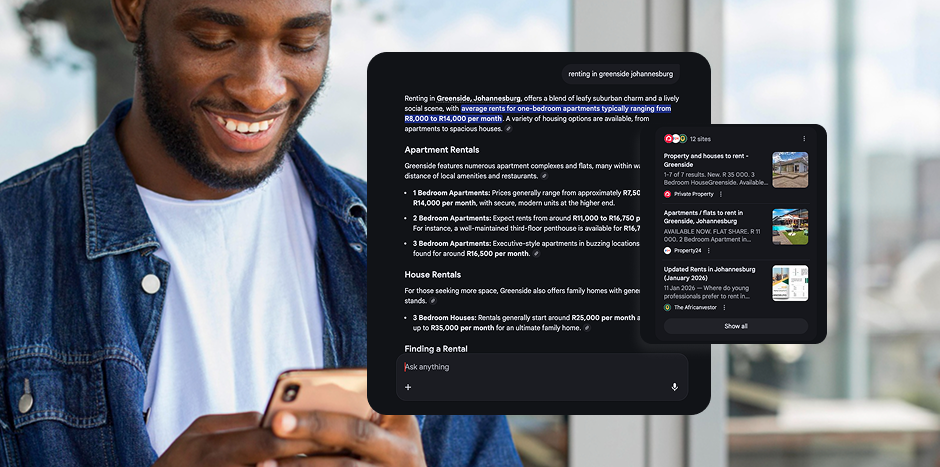
Google's AI Mode is now live for all South African users, and it’s turning the SEO world upside down. While many marketers are sounding the alarm over dropping traffic and reduced click-through rates, the reality is a bit different, especially for the real estate industry.
Yes, this is a major shift in how search works. But if you’re running a real estate website and doing SEO the right way, there’s no need to panic. In fact, this could be a massive opportunity.
Real estate sites with authority are winning
Across multiple real estate clients, a clear pattern is emerging: websites with strong topical authority, local expertise, and trust signals are being cited more often by Google’s AI. That means more visibility, higher credibility, and better-quality traffic.
AI Mode isn’t the end of SEO—it’s the end of weak, outdated SEO strategies. Here's how we’re adapting our content strategy for real estate sites to thrive in this new era:
1. From keywords to topic clusters
We’re shifting from individual keyword targeting to topic clustering — building full content ecosystems around key real estate themes like:
- Buying your first home
- Renting in [City Name]
- Understanding home loan pre-approvals
- Real estate investment in [Area]
By covering each topic comprehensively through interlinked articles, we help position your website as the go-to authority in your area.
2. Focusing on AEO (Answer Engine Optimisation)
AI Mode favours content that clearly answers questions, not just what users type, but what the AI interprets from their intent.
We're creating content that:
- Uses structured headings
- Provides straightforward answers
- Includes local facts, data, and examples to strengthen authority
Think of it like building a rich FAQ for every property topic that AI can easily quote and cite.
3. Creating multi-layered content
Homebuyers and sellers don’t ask one question — they ask ten. AI Mode now processes these layers through "query fan-out", where one question triggers multiple related searches.
Our approach? Write articles that anticipate follow-up questions like:
- What are the hidden costs of buying a home?
- Should I buy or rent in [Location] in 2025?
- What’s the resale value for properties in [Suburb]?
This keeps users engaged and makes your site more useful and more likely to be surfaced in AI-powered results.
4. Building real estate authority through backlinks
AI Mode relies on E-E-A-T (Experience, Expertise, Authoritativeness, and Trust). For real estate websites, this means earning backlinks from:
- Reputable real estate blogs and publications
- Local news websites
- Industry directories and associations
These links tell Google that you’re a trusted source of information, not just another listing site.
Final thought
We’ve weathered algorithm updates, ranking shifts, and changing user behaviour. AI Mode is just the next evolution—and one that rewards real estate websites built on quality, clarity, and trust.
If your content shows deep knowledge of the property market, helps users make informed decisions, and demonstrates your local authority, you’ll not only survive this shift — you’ll grow from it.
Ready to be the real estate agency Google’s AI recommends?
With our specialised real estate SEO and content services, we can help your business become the source Google’s AI trusts and cites. From building topical authority and location-based content clusters to crafting AI-friendly, answer-driven articles and earning high-quality backlinks, we can make your website impossible to ignore. Let us position your brand as the expert Google turns to — and the agency clients remember.